
The Scottish knight who brought Robert the Bruce's heart to Teba
Sir James Douglas died in 1330 beside the castle of Teba, where he had arrived with the embalmed heart of the King of Scotland. What the chronicles say and what legend added do not always coincide. A monument has commemorated him since 1989.
InforMálaga newsroom ·
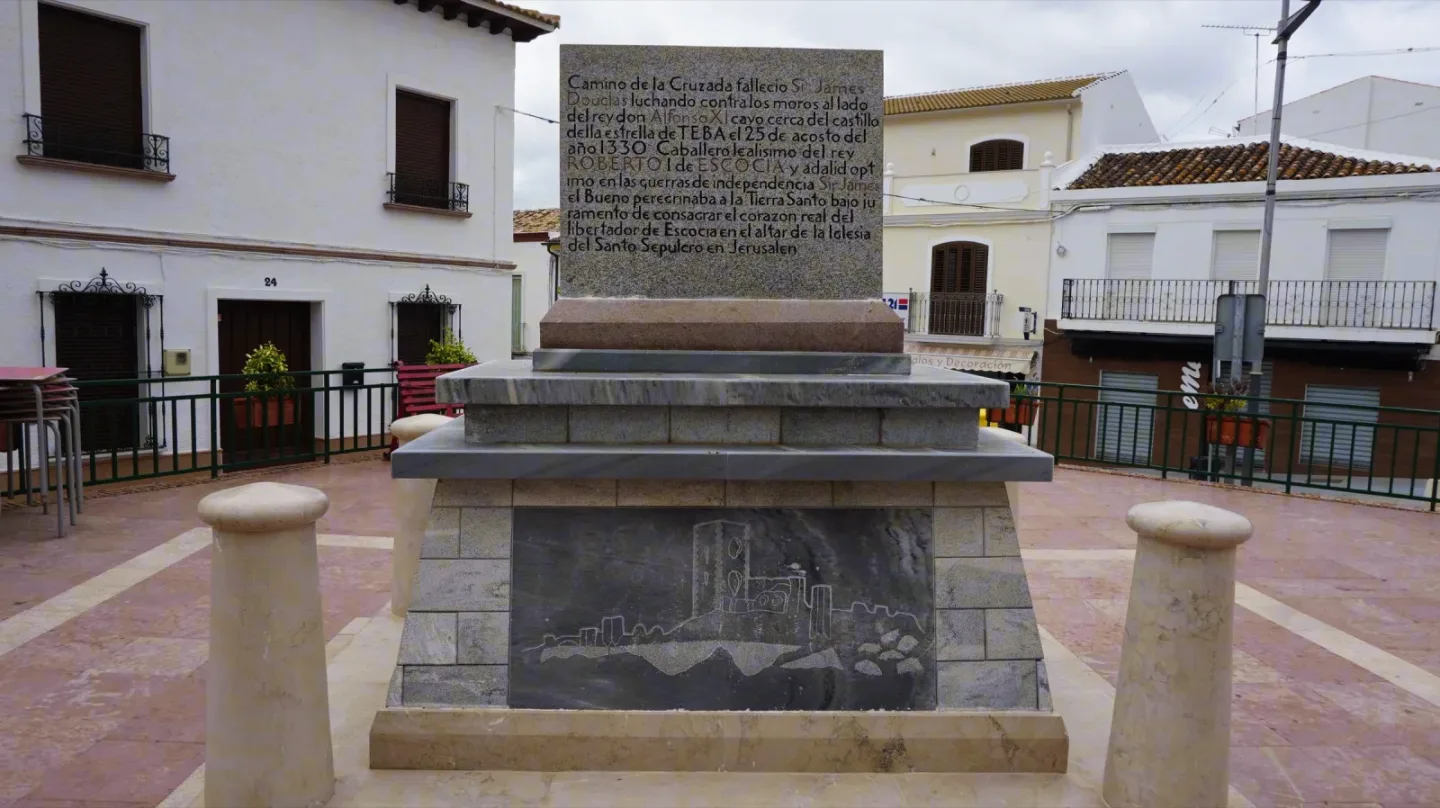
In the Plaza de España in Teba there is a slab with golden letters that commemorates a Scottish knight who died in 1330. His name was Sir James Douglas and he travelled with a silver casket hanging around his neck. Inside was the embalmed heart of Robert the Bruce, King of Scotland.
The story has a documented part and another that grew over the centuries. It is worth separating them.
What the chronicles say
Robert the Bruce died in 1329. Before that he asked Douglas to take his heart far from Scotland. On the destination, the sources of the time disagree. The chronicler Jean le Bel wrote that the king wanted the heart to reach the Holy Sepulchre in Jerusalem. The Scottish poet John Barbour, author of «The Bruce», says it had to go to battle against the enemies of God.
At the beginning of 1330 Douglas set sail from Berwick with seven knights and some twenty squires. He passed through the Flemish port of Sluys and carried a letter of introduction from King Edward III of England. According to Barbour, Alfonso XI of Castile received him with honours in Seville. The Castilian king was preparing a campaign against the Nasrid kingdom of Granada and Douglas joined his army, which laid siege to the castle of Teba.
To relieve the fortress, an army sent by Uthman ibn Abi al-Ula arrived from Granada, with some 6,000 horsemen according to the Wikipedia encyclopedia. Douglas died in those combats. The date that appears in the inscription in Teba and in the Wikipedia entry is August 25, 1330.
How he died is less clear. The Gran Crónica de Alfonso XI speaks of a «foreign count» who fell through his own error in a skirmish days before the main battle, and some historians believe it refers to Douglas. Others, following Barbour, place his death in the battle. According to Barbour, Sir William de St Clair and the brothers Robert and Walter Logan died with him. The garrison of Teba surrendered shortly afterwards.
What the legend added
The best-known scene, that of Douglas throwing the casket with the heart at the enemy before leaping after it, is not in Barbour's original poem. According to Wikipedia, it comes from a 16th-century addition, and it was Walter Scott who turned it into Douglas's final gesture in his «Tales of a Grandfather».
Names of other companions and supposed links with the Templars also circulate. Wikipedia notes that there is no evidence of those companions nor any historical basis for the Templar connection.
According to Barbour, the companions who survived recovered the body and the casket. Douglas's bones were taken to Scotland and buried in the church of St Bride, in the town of Douglas. The king's heart was buried beneath the high altar of Melrose Abbey.
The slab in the Plaza de España
The monument in Teba was inaugurated on August 25, 1989, according to the municipal heritage website Conoce Teba. It is the work of the Scottish sculptor Hew Lorimer, weighs around one tonne and was paid for with private donations. A descendant of Douglas, Douglas Mackintosh, had arrived in Teba with the slab in the summer of 1988.
On the relationship with Melrose there are different versions. The Town Council's website states that Teba is twinned with the Scottish town. Conoce Teba explains that in 1993 the Town Council and the Consulate of Spain in Scotland began moves to twin them, but that the project proved unviable for financial reasons raised by the Scottish side.
Since 2005 the town has held the Douglas' Days Scottish Festival, recognised by the Diputación de Málaga as a Fiesta de Singularidad Turística Provincial.
Breaking news from News, on your phone
An alert only when something can't wait. Free, no account needed.
On iPhone, alerts only arrive if you first add InforMálaga to your Home Screen. How to do it, step by step
This browser can't receive alerts. Try another one, such as Chrome or Safari.
You've blocked alerts from InforMálaga in this browser. You can turn them back on in its settings. How to do it, step by step
Only what can't wait. Change or remove it in my alerts
Shall we let you know what matters?
Phone alerts
On iPhone, alerts only arrive if you first add InforMálaga to your Home Screen. How to do it, step by step
This browser can't receive alerts. Try another one, such as Chrome or Safari.
You've blocked alerts from InforMálaga in this browser. You can turn them back on in its settings. How to do it, step by step