A doctoral thesis from the Universidad de Málaga creates an architecture that unifies perception, decision-making and movement to advance toward highly autonomous surgical robots.
InforMálaga newsroom
·
Photo: Universidad de Málaga · Sala de prensa
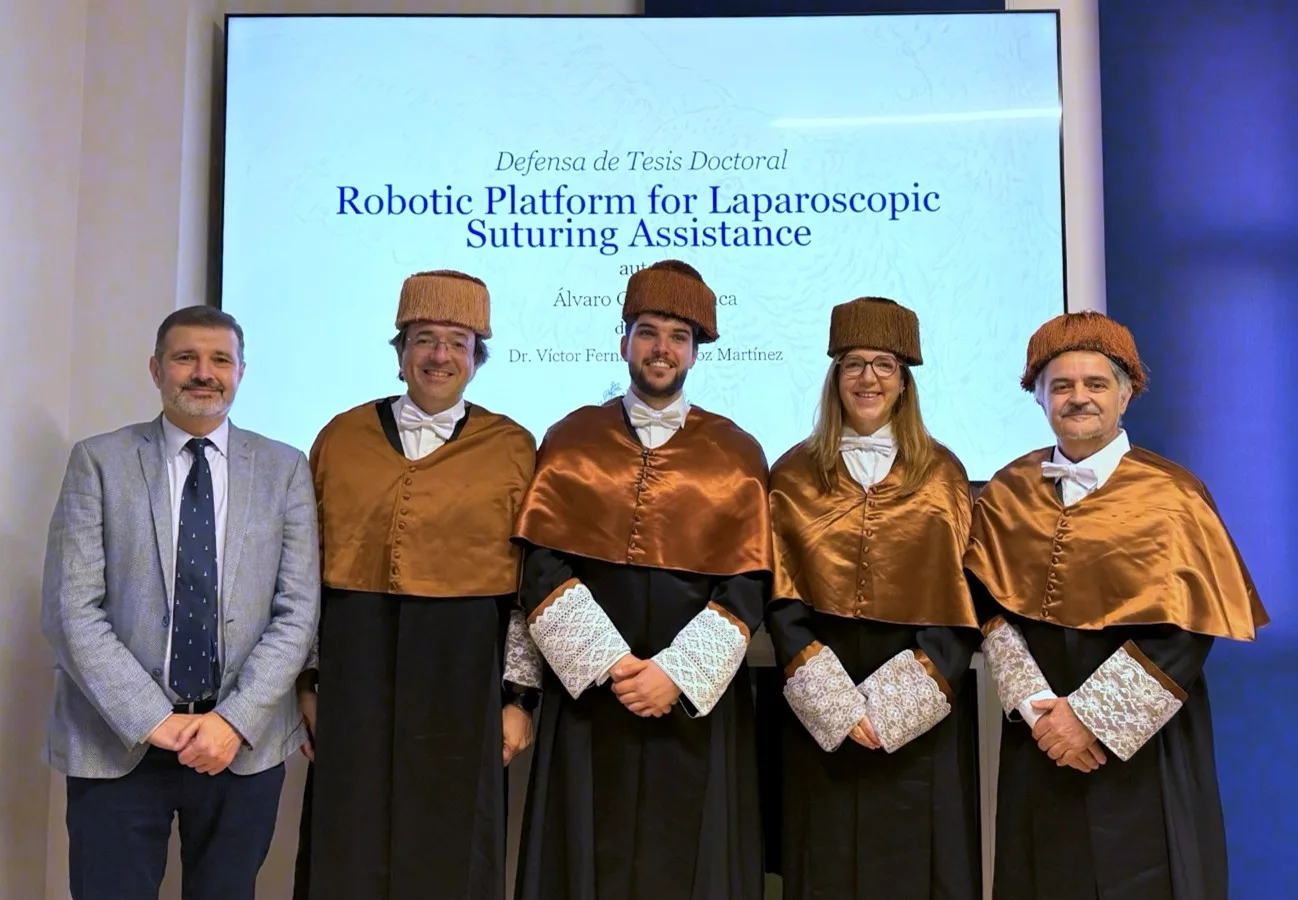
A researcher at the University of Málaga (UMA) has developed a system that allows surgical robots to make decisions more autonomously during an operation, while at the same time reducing the damage caused to the patient's tissues. The work is part of the doctoral thesis of Álvaro Galán, defended at the UMA and supervised by professor Víctor Muñoz at the Medical Robotics and Digital Twins Laboratory of the University Institute of Research in Mechatronic Engineering and Cyber-Physical Systems (IMECH.UMA).
An architecture that connects perception, decision and movement
According to the UMA, until now surgical robots managed to perform specific tasks, such as cutting or suctioning, but each program worked in isolation, without communicating continuously with the rest of the system. Galán's thesis develops an architecture that integrates perception of the environment, logical reasoning and movement control into a single continuous process, which the university places within what is known as Level 4 of surgical autonomy, prior to full automation.
Decisions that can be verified
One of the aspects of the work is the way in which the safety of the decisions made by the robot is guaranteed. Instead of resorting to artificial intelligence models whose reasoning cannot be reviewed, known as "black boxes", the system uses a mathematical framework based on ontologies and description logics. According to the UMA, this allows each autonomous decision of the robot to be transparent, predictable and verifiable within a time determined by the medical team supervising the intervention.
Measuring force without sensors inside the patient
Another of the problems addressed by the research is that, in minimally invasive surgery, the robotic instrument passes through the abdominal wall through a small incision (the trocar), which mixes the resistance of that incision with the force the robot actually exerts on the internal organs. To solve this without introducing additional sensors into the patient, Galán applies a viscoelastic mathematical model that allows the exact force exerted on the tissue to be isolated with a relative error margin of nine percent.
Results in laboratory tests
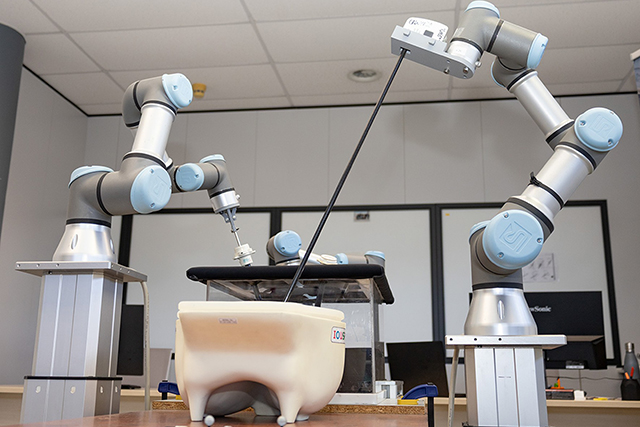
The system has been tested on a two-arm robotic platform that recreates the conditions of laparoscopic surgery. In suture planning, it identified the shape of the wounds and placed the stitches with 85 percent success and an error margin of less than 2.5 millimetres. In supervision during the operation, it recognised the phases of the surgery with a latency of 0.75 seconds and reacted to failures or excessive pressures.
According to the data provided by the UMA, the adaptive movement control system managed to reduce tissue trauma by 56.5 percent compared with other control strategies tested on the same platform, by automatically reorienting the instruments to avoid force peaks on the abdominal wall.
The thesis has been awarded the grade of sobresaliente cum laude with international mention within the UMA's Doctoral Programme in Mechatronic Engineering.
Share this story
Breaking news from News, on your phone
An alert only when something can't wait. Free, no account needed.
On iPhone, alerts only arrive if you first add InforMálaga to your Home Screen.
How to do it, step by step
This browser can't receive alerts. Try another one, such as Chrome or Safari.
You've blocked alerts from InforMálaga in this browser. You can turn them back on in its settings.
How to do it, step by step