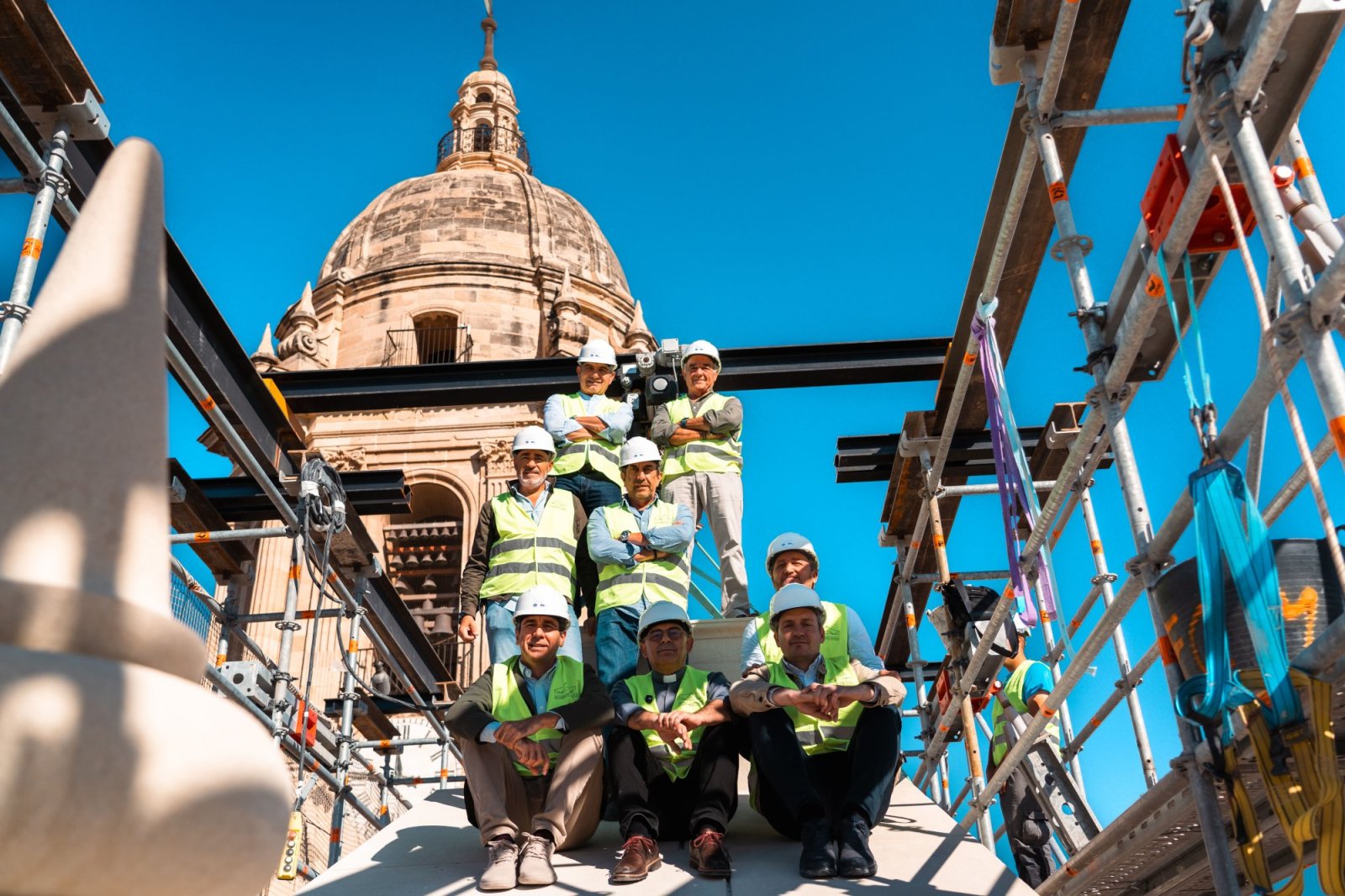
The pediment of the main façade of the Cathedral of Málaga is now complete. The placement of the last stone closes a finish that was left half-done when the works were halted, 244 years ago, and that has now been able to be completed because the new roof of the temple required resolving its meeting with that façade, according to the Diócesis de Málaga.
The design that has been executed is not new: it follows the layout recorded in the engraving by Francisco Muntaner from 1784, included in a collection published in 1785, and the Cathedral's system of proportions, linked to the rules of the Italian Renaissance treatise writer Jacopo Barozzi da Vignola. In the second half of the 18th century, the architect Antonio Ramos replaced the curved pediment planned by José de Bada with a triangular solution, a change that the Diócesis attributes to the intention of adapting the finish to the gabled roof proposed in 1764 by Ventura Rodríguez, architect of the Real Academia de Bellas Artes de San Fernando.
Adjustments to an irregular fabric
The work has not consisted of copying a drawing, but of fitting it into what was already built. The oculi and the preserved elements present irregularities, which has made it necessary to adjust the new pieces to give continuity to the whole. For this, Bateig stone has been used, from Alicante, chosen for its similarity in composition, tone and texture to the existing fabric, related to the supply from the old Almayate quarries, in the area of Valle Niza.
The UTE Hermanos Campano–Grupo ORP has relied on Bateig to make the pieces and on a specialised company from Jaén to place them. The ashlars, which in some cases weigh close to two and a half tonnes, have been jointed with lime mortar and river sand, following the Cathedral's traditional technique. In addition, glass fibre rods and hidden stainless steel stapling have been incorporated to improve the fabric's response to possible seismic movements.
To set the pieces, a gantry crane structure with a hoist has been mounted on the scaffolding, which allows the movements to be controlled and each ashlar to be adjusted without depending on the swings of the main crane. The scaffolding has thus served a double function: giving access to the workers and supporting the placement system, contracted by the UTE to the company Catari.
Removal of the scaffolding
In the coming days the structure that has supported the gantry crane will be removed and the scaffolding will be reconfigured to restore the historical part of the pediment. The Diócesis maintains that the completion of this finish represents significant progress in the works on the Cathedral's roofs.
Share this story
Breaking news from News, on your phone
An alert only when something can't wait. Free, no account needed.
On iPhone, alerts only arrive if you first add InforMálaga to your Home Screen.
How to do it, step by step
This browser can't receive alerts. Try another one, such as Chrome or Safari.
You've blocked alerts from InforMálaga in this browser. You can turn them back on in its settings.
How to do it, step by step