New clues identify the Cabopino wreck as the ship 'Garigliano'
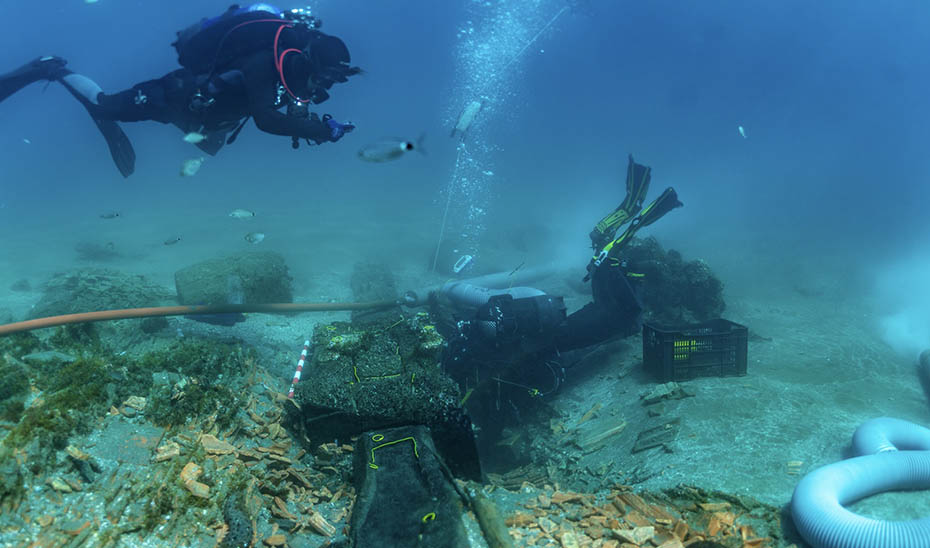
The Centre for Underwater Archaeology has completed fifteen days of work on the Cabopino wreck, off Marbella, with data pointing to the Italian barquentine sunk in 1887.
FJCG
·
Photo: Junta de Andalucía · Portavoz
The archaeological work on the Cabopino wreck, off the coast of Marbella, has provided new clues suggesting that the remains correspond to the Italian barquentine 'Garigliano', sunk in 1887 during a storm. This is stated by the Instituto Andaluz del Patrimonio Histórico (IAPH), which has completed the intervention through its Centre for Underwater Archaeology (CAS), under the Consejería de Cultura, Patrimonio Histórico y Deporte of the Junta de Andalucía.
Fifteen days of campaign
The campaign lasted fifteen days and also involved the University of Granada. The IAPH expects further dives to be carried out in 2027 to deepen the research, which is not yet concluded.
Historical documentation indicates that the 'Garigliano' was covering a voyage from Marseille bound for Buenos Aires when it sank off the coast of Marbella. This type of vessel could reach approximately 45 metres in length, and so far 34 visible metres of the structure have been documented.
What has been found
The study of the naval architecture continues to confirm that the wreck corresponds to a transoceanic merchant transport vessel from the last third of the 19th century, which sailed in the commercial networks between Europe and America. The work has made it possible to pinpoint the position in which the ship ended up after the shipwreck: it ran aground with its bow towards the beach and a pronounced list to port, and everything suggests that both sides ended up opening and falling outwards, possibly due to the weight of the cargo.
Two archaeological test pits have been carried out, one in the bow area next to the foremast step and another in the central area next to one of the preserved bulkheads, and two cleaning operations, one on the starboard side and another on an area of the cargo, where different stowage levels have been observed.
Among the cargo, four different tile productions have been identified. Three bear manufacturer's marks from southern France (Pierre Lançon, Roux B. Martin and A. Remuzat), linked to production centres in the Marseille and Aubagne area in the 19th century, and a production of tiles by Pierre Sacoman, in Saint-Henri de Marseille, has also been documented. Particularly notable is the location of 26 barrels; historical documentation indicates that the ship was carrying Roman cement, one of the open lines of research. Some barrels appear to retain part of their contents and samples have been taken to determine their nature.
Samples and 360-degree documentation
Samples of wood have also been taken, to identify the species used in the construction, and of the copper sheathing of the hull, for the technological study of the vessel. The intervention has been accompanied by a graphic and audiovisual documentation programme, with 360-degree videos and photogrammetry to generate a three-dimensional model of the wreck.
The regional minister of Culture, Historical Heritage and Sport, Patricia del Pozo, has highlighted the work of the CAS scientific team for «providing new data for the knowledge of our common past, through the investigation of the historical vestiges found on the seabed of the Andalusian coasts».
Share this story
Breaking news from News, on your phone
An alert only when something can't wait. Free, no account needed.
On iPhone, alerts only arrive if you first add InforMálaga to your Home Screen.
How to do it, step by step
This browser can't receive alerts. Try another one, such as Chrome or Safari.
You've blocked alerts from InforMálaga in this browser. You can turn them back on in its settings.
How to do it, step by step