An international team with La Mayora participation sequences the genome of the alga Spirogyra
Researchers from IHSM La Mayora (UMA-CSIC) have taken part in sequencing the genome of Spirogyra pratensis, an alga key to understanding how plants moved from water to land. Their contribution is a freely accessible genomic platform.
FJCG
·
Photo: IHSM La Mayora (UMA-CSIC)
An international scientific team has published the genome of Spirogyra pratensis, an alga from the lineage evolutionarily closest to land plants. The work appears in the journal The Plant Cell and combines whole-genome sequencing with a profile of its gene activity throughout its life cycle and under different light and temperature conditions.
A window into the leap from water to land
Spirogyra belongs to the class Zygnematophyceae, a group of streptophyte algae that possesses cellular and molecular tools related to the transition from water to land during plant evolution. According to those responsible for the study, these data help reconstruct that step.
An open platform for the scientific community
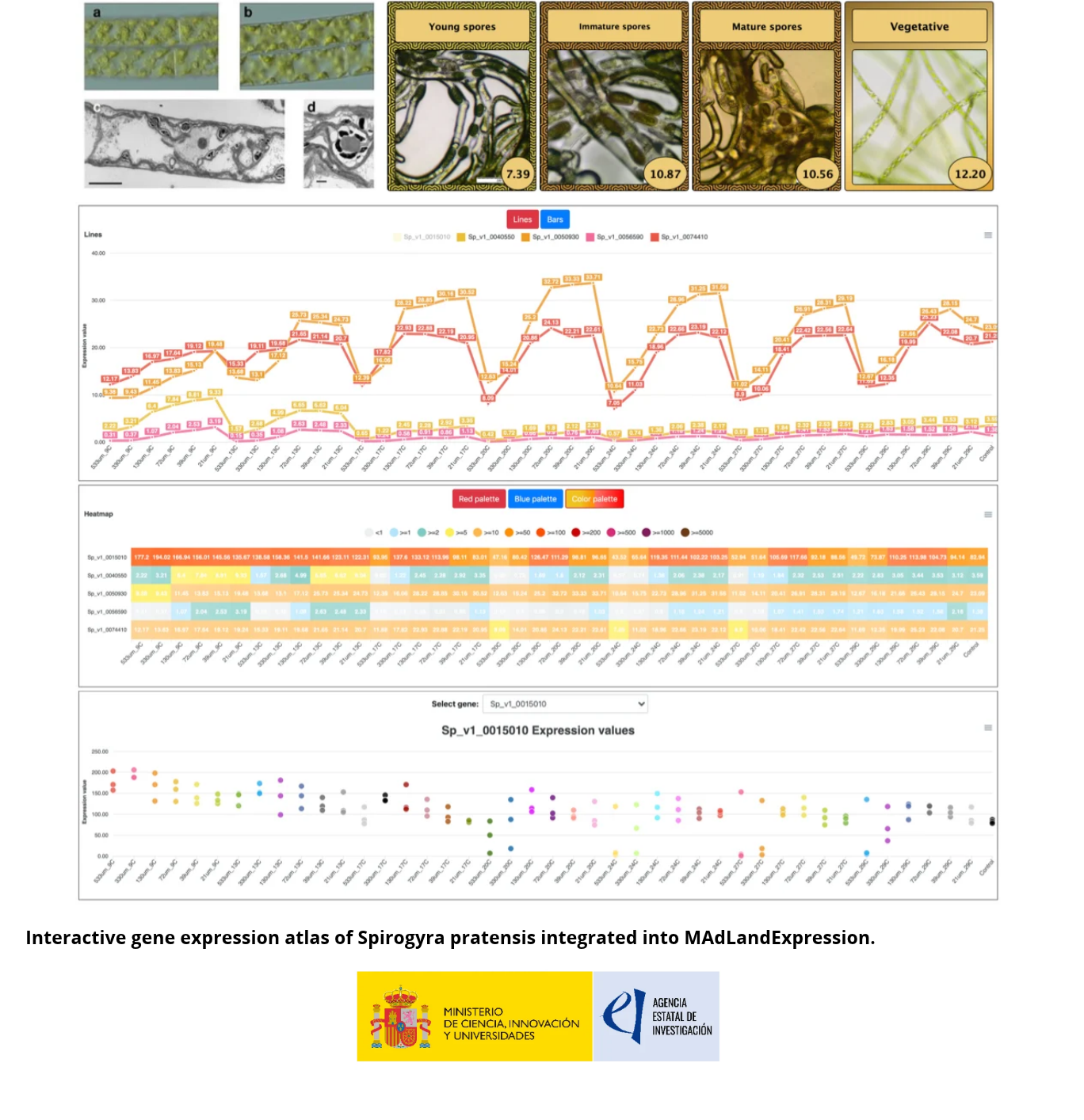
Two researchers from the Instituto de Hortofruticultura Subtropical y Mediterránea La Mayora (IHSM La Mayora, UMA-CSIC), Enrique López Gómez and Noé Fernández Pozo, have taken part in the work. Their contribution has been the development of MAdLandExpression, an interactive genomic platform that brings together the gene expression data obtained in the study.
The tool, built with EasyGDB, organizes and makes freely available the data sets generated for Spirogyra and other seedless plants. It offers interactive graphs and comparison tools so that researchers around the world can explore the activity of their genes.
Who signs the work
The research is led by scientists from the German universities of Göttingen and Freiburg, with the participation of the La Mayora team. The results have been published in The Plant Cell.
How to consult the data
The gene expression data sets are freely available on the MAdLandExpression platform, accessible through the project website.
Share this story
Breaking news from News, on your phone
An alert only when something can't wait. Free, no account needed.
On iPhone, alerts only arrive if you first add InforMálaga to your Home Screen.
How to do it, step by step
This browser can't receive alerts. Try another one, such as Chrome or Safari.
You've blocked alerts from InforMálaga in this browser. You can turn them back on in its settings.
How to do it, step by step