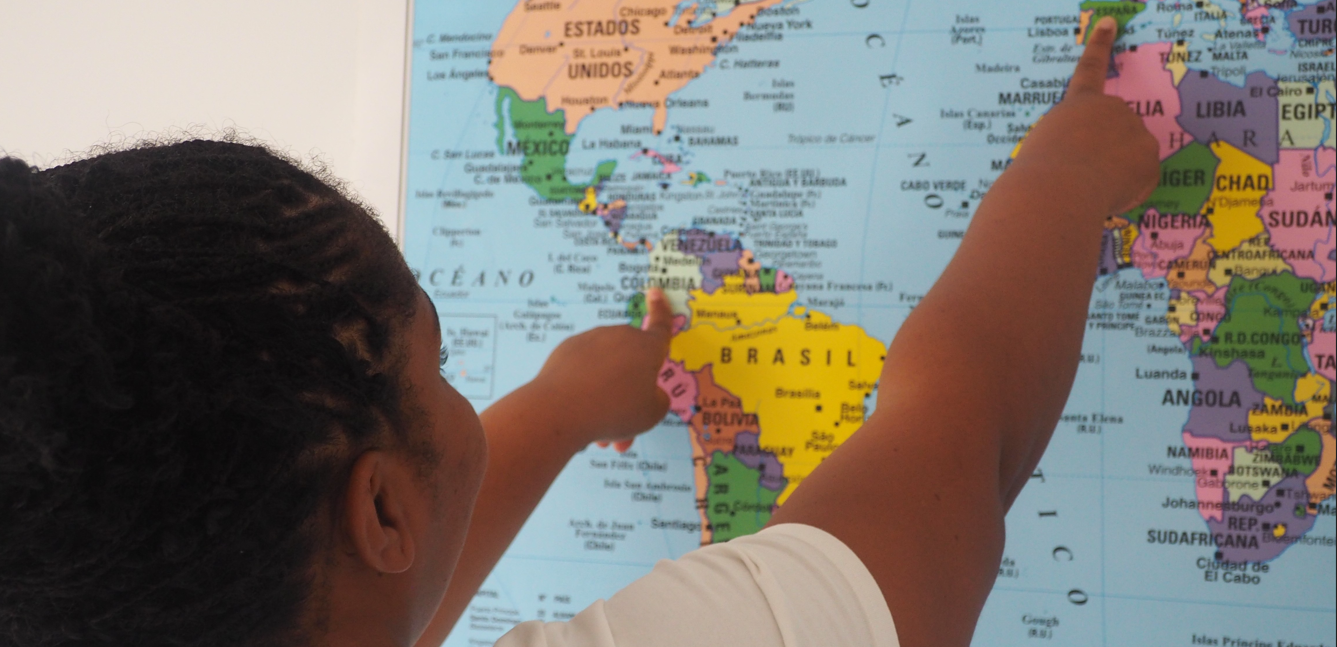
The woman, Colombian and in Spain for eight months, begins this week caring for an elderly person in Fuengirola, a job that will allow her to eat with her 8-year-old daughter after school. She lives in one of the reception flats of Málaga Acoge.
Leitava —a fictitious name to protect her identity— starts this week working several hours a day caring for a dependent elderly woman in Fuengirola, whom she will accompany and help with cleaning the house. She trusts she will keep the position because the schedule will allow her to eat with her 8-year-old daughter when the girl leaves school.
She arrived in Spain eight months ago with her daughter from Colombia. According to her, she was looking for what she could not find in her town: «The town where I lived always had a lot of violence, it was a dangerous area. There is a great shortage of opportunities to get ahead». Her decision, she adds, was to give the girl «the opportunity to grow up in a safe environment».
From a hostel to a shared flat
Her first stage in Spain was in a hostel managed by the Spanish Commission for Refugee Aid (CEAR). Now she shares one of the four reception flats that Málaga Acoge maintains in Fuengirola with a Ukrainian woman and her two small daughters. She has been in the home for three months.
The association details that the support for Leitava is part of its reception and social inclusion programme for applicants for international protection, which has the support of the Ministry of Inclusion, Social Security and Migrations. The programme is carried out in Fuengirola and la Axarquía with 39 places distributed across eight flats: 18 in Fuengirola, in four homes, and 21 in la Axarquía, also in four flats.
Training and goals
Since her arrival in Málaga she has continued training: she finished Compulsory Secondary Education (ESO), took a Home Help course and is now taking another online course in Activities and Sales. She is also advancing in English on her own. Her goal, she points out, is «to have stability for myself and for my girl» and to bring her mother from Colombia.
Her main concern is access to housing when she leaves the reception flat: «When I leave, finding a home is complicated and rental prices are sky-high».
The rest of the reception network
In la Axarquía, the flat in Torre del Mar, intended for women in situations of special vulnerability, has six places, with five occupied. The one in Vélez-Málaga has six places, five occupied by people from Mali and Ukraine. In Caleta de Vélez, a flat with 14 places hosts two Ukrainian families. In addition, 13 families —28 people— live in other flats in the autonomy phase; five of them are working, many in construction, and one woman is self-employed in a hairdressing salon.
Share this story
Breaking news from News, on your phone
An alert only when something can't wait. Free, no account needed.
On iPhone, alerts only arrive if you first add InforMálaga to your Home Screen.
How to do it, step by step
This browser can't receive alerts. Try another one, such as Chrome or Safari.
You've blocked alerts from InforMálaga in this browser. You can turn them back on in its settings.
How to do it, step by step